
Dec 18, 2025
Your Sewer Line Isn’t “Old.” It’s Failing in One of These 6 Places. Here’s How to Find It Before It Finds You.
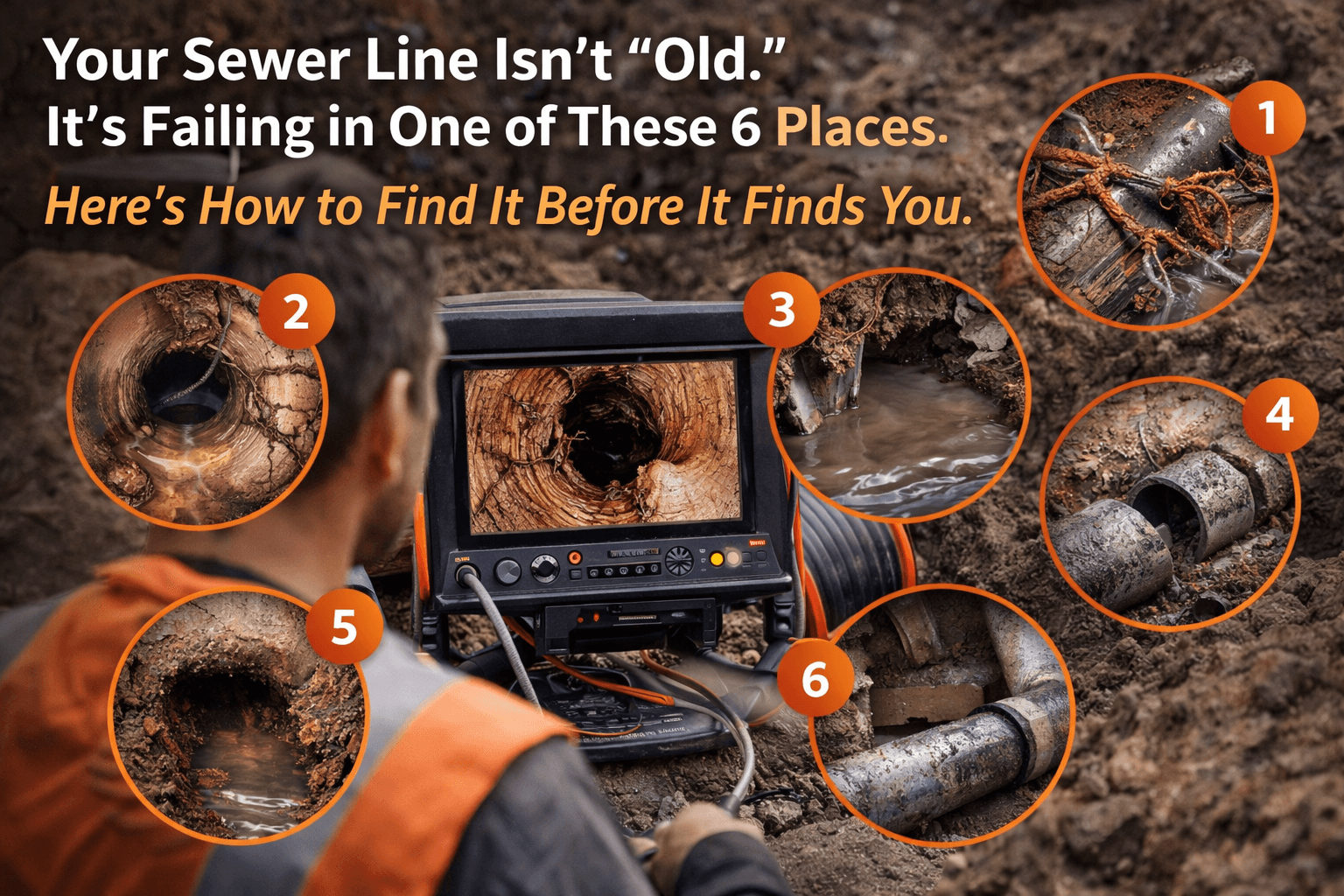
Your Sewer Line Isn’t “Old.” It’s Failing in One of These 6 Places. Here’s How to Find It Before It Finds You.
The problem with sewer issues: they don’t get better
Most homeowners wait because the symptoms come and go. A slow drain one week, fine the next. A “gurgle” after laundry day. A smell that disappears when you open a window.
Sewer lines fail gradually, until they don’t. And the most expensive repairs aren’t caused by “bad luck,” they’re caused by uncertainty (guessing) and delay (damage spreading).
If you’re seeing warning signs, here’s what’s usually happening underground, and how a good contractor pinpoints the exact fix without tearing up your yard.
The 6 most common sewer line failure points (and what they look like)
Most sewer repairs aren’t a mystery. They’re one of these:
1) Root intrusion at joints
Older lines often have joints every few feet. Roots don’t “crush” pipes at first—they find tiny gaps and grow into them.
Signs: slow drains that come and go, recurring clogs, backups after heavy use
What the camera shows: hair-like roots at first, then thick mats that catch debris
2) Belly (sag) in the pipe
A “belly” is a low spot where water and solids sit instead of flowing out.
Signs: frequent clogs even after snaking, sluggish drains, problems worsen over time
Reality: you can clear it temporarily, but gravity doesn’t negotiate—this often needs correction
3) Collapsed or cracked section
This is where backups become emergencies.
Signs: sudden, repeated backups; multiple fixtures affected; sometimes sinkholes/soft spots outside
What causes it: age, soil movement, heavy loads above, previous poor repairs
4) Offset joints (pipe shifted apart)
Even a small misalignment becomes a “catch point” for toilet paper and waste.
Signs: repeated clogs, especially after flushing; works “fine” until a heavy-use day
Camera clue: a visible lip where flow snags
5) Corrosion or pipe scaling (common in cast iron)
Over time, interior buildup narrows the pipe.
Signs: slow drains across the house, frequent blockages, backups despite clearing
Camera clue: rough, flaky interior; reduced diameter
6) Failure at the transition point
Where pipe materials change (cast iron to PVC, clay to PVC), problems often start.
Signs: intermittent blockages and recurring issues “around the same time”
Why: transitions are where joints, adapters, and soil stress combine
What a real diagnosis looks like (and what “guessing” looks like)
A sewer problem shouldn’t be diagnosed by vibes.
Good process:
Identify symptom pattern (one drain vs whole house)
Locate cleanout access (or recommend adding one if needed)
Camera inspection to see the issue and measure distance
Confirm depth and path if digging is involved
Recommend repair options with tradeoffs
Guessing looks like:
“We’ll just snake it again.”
“Probably roots.”
“Let’s dig here because it’s the easiest spot.”
The camera isn’t just about seeing the problem. It’s about mapping it so the repair is targeted, not exploratory.
The 4 repair paths (and when each is smart)
Option A: Spot repair (excavation + replace a section)
Best when damage is localized (one collapsed section, one offset joint).
Pros: permanent fix for that section
Cons: requires digging; landscaping restoration may be needed
Option B: Pipe relining (if structurally suitable)
A new “pipe within a pipe” that seals cracks and joints.
Pros: minimal disruption; great for root intrusion and small cracks
Cons: not always possible if pipe is collapsed/bellied; needs the right pipe condition
Option C: Pipe bursting (replace with minimal trenching)
Old pipe is fractured outward while new pipe is pulled in.
Pros: replaces the whole run with less digging
Cons: requires access pits; not perfect for every layout
Option D: Grade correction (fix a belly)
If the line has a sag, the true fix often means regrading that section.
Pros: resolves recurring clogs for good
Cons: typically excavation; the “unsexy” but correct fix
7 questions that instantly reveal if a sewer contractor is legit
Will you camera the line and show me the footage?
Can you tell me the distance to the defect from the cleanout?
Is the issue a belly, roots, collapse, or offset joint—and how do you know?
What repair options exist besides digging everything up?
If you recommend trenchless, what pipe condition disqualifies it?
Will you handle restoration or coordinate it?
Do you provide a written scope with assumptions listed?
What to do right now if you suspect sewer trouble
Stop using water heavily if multiple fixtures are backing up
Avoid chemical drain cleaners (they don’t fix sewer issues and can complicate work)
Book a camera inspection before you book a full repair
Ask for the footage + the measured distance so you can make a confident decision
If you want a clear next step: a camera inspection + honest explanation of repair paths is the fastest way to reduce cost and stress.